
 Discussion
Obexelimab for IgG4-related disease
Last updated May 29, 2025, by Marisa Wexler, MS
 Fact-checked by Marta Figueiredo, PhD
What is obexelimab for IgG4-RD?
Obexelimab is an experimental injectable therapy that Zenas Biopharma is developing for immunoglobulin G4-related disease (IgG4-RD).
Administered through under-the-skin, or subcutaneous, injections, the therapy is designed to block the activity of B-cells, a type of immune cell. In IgG4-RD, the matured form of B-cells, plasmablasts, form clumps inside tissues and make large amounts of a type of antibody called IgG4.
B-cells and plasmablasts contribute to the inflammation and scarring that mark IgG4-RD, and are thought to play a major role in driving disease flares, where symptoms suddenly worsen.
Obexelimab, previously known as XmAb5871, is an antibody-based therapy that specifically targets CD19 and FCGR2B, two proteins found at the surface of B-cells that help regulate the cells’ activity, including the production of antibodies and inflammatory molecules, and activation of other immune cells.
By binding to these two proteins, the therapy is expected to suppress the activity of several populations of B-cells, including plasmablasts, ultimately reducing IgG4-RD activity and the risk of flares, or relapses.
Because B-cells are normally involved in fighting against infectious agents and obexelimab does not cause deep and persistent B-cell depletion, the therapy is not expected to be associated with a higher risk of infection.
Zenas is also evaluating obexelimab’s potential as a therapy for other immune-mediated diseases.
Therapy snapshot
Scroll horizontally to view all columns -->
| Treatment name: | Obexelimab |
| Administration: | Being tested in IgG4-RD as a subcutaneous injection |
| Clinical testing: | Currently in a Phase 3 clinical trial |
How will obexelimab be administered in IgG4-RD?
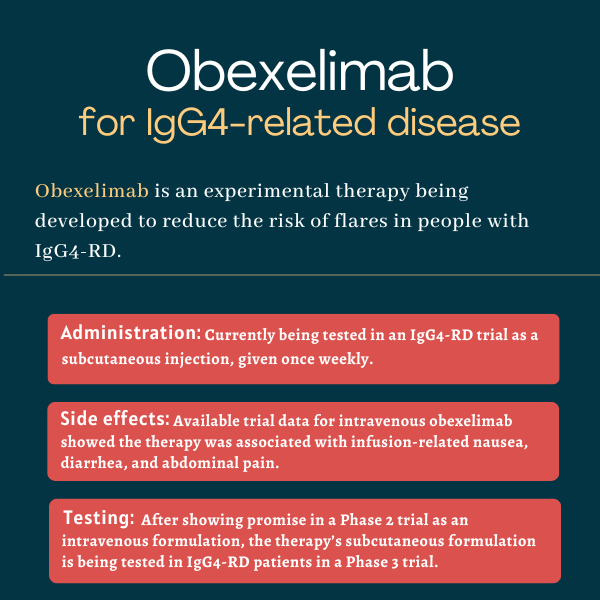
Obexelimab is designed to be administered by subcutaneous injection. While a pilot Phase 2 trial tested an into-the-vein, or intravenous, formulation in IgG4-RD patients, an ongoing Phase 3 trial is evaluating a subcutaneous formulation of obexelimab, given once weekly at a dose of 250 mg.
Obexelimab in IgG4-RD clinical trials
The effects of obexelimab in IgG4-RD have been evaluated in a Phase 2 trial (NCT02725476), where 15 adults with active IgG4-RD received intravenous infusions of obexelimab, at a dose of 5 mg/kg, every other week for 24 weeks (nearly six months). Results showed that:
- All but three participants were considered primary responders, defined by a 2-point or greater reduction in the IgG4-RD responder index (IgG4-RD RI) score, where higher scores indicate more severe disease, after 24 weeks. All primary responders were also able to discontinue glucocorticoids (standard first-line treatment) after about two months, and experienced no flares.
- All but one participant were deemed responders, defined by an IgG4-RD RI score drop of at least two points at any study visit.
- Eight patients (53%) achieved complete remission, defined as an IgG4-RD RI score of zero (no symptoms) after 24 weeks, no need for glucocorticoids after about two months, and no flares.
- Blood counts of B-cells and plasmablasts were reduced, but generally recovered within a month or two of stopping obexelimab treatment.
A global Phase 3 study, called INDIGO (NCT05662241), is testing obexelimab against a placebo, when given as subcutaneous injections once a week for a year, in 194 adults with active IgG4-RD that requires glucocorticoids. The study’s main goal is to see if obexelimab is better than the placebo at delaying the time to first IgG4-RD flare. Top-line results are expected in late 2025.
Obexelimab side effects in IgG4-RD
In the completed Phase 2 study that tested intravenous obexelimab in people with IgG4-RD, the most commonly reported adverse events deemed related to the therapy were infusion-related gastrointestinal problems such as:
- nausea
- abdominal pain
- diarrhea.
IgG4-RD News is strictly a news and information website about the disease. It does not provide medical advice, diagnosis, or treatment. This content is not intended to be a substitute for professional medical advice, diagnosis, or treatment. Always seek the advice of your physician or other qualified health provider with any questions you may have regarding a medical condition. Never disregard professional medical advice or delay in seeking it because of something you have read on this website.
Related articles
-
Discussion
-
 Discussion
-
 Discussion
-
Discussion
-
 Discussion
-
 Discussion