IgG4-RD prevalence
 Fact-checked by
 While immunoglobulin G4-related disease (IgG4-RD) is generally considered rare, the exact IgG4-RD prevalence is not established, and estimates vary by geographical region.
The disease occurs when the immune system goes into overdrive, resulting in immune cell infiltration into tissues, which leads to inflammation, scarring, and the formation of tumor-like masses or enlargements. The underlying IgG4-RD causes aren’t entirely understood, but this process can happen in virtually any organ, leading to a wide range of possible IgG4-RD symptoms.
Researchers believe IgG4-RD is likely underdiagnosed, which makes it difficult to know how common the disease is and which populations are most affected by it. With advances in disease recognition and diagnostic practices, a better understanding of the epidemiology of IgG4-RD may emerge in the coming years.
How many people have IgG4-RD?
To understand how common a disease is, scientists examine two types of data: prevalence, which assesses the number of people living with the disease, and incidence, which reflects the number of new cases diagnosed within a given time period.
Scientists don’t have a concrete estimate of the global prevalence of IgG4-RD, nor of its global incidence, but some studies have examined how common IgG4-RD is in specific countries.
IgG4-RD incidence and prevalence
Most available data on IgG4-RD incidence and prevalence comes from the U.S. and Japan. A 2023 U.S. study based on insurance claims data found:
- The 2015 IgG4-RD incidence was 0.78 per 100,000 person-years, meaning that if 100,000 people were followed that year, 0.78 new IgG4-RD diagnoses would be expected. This rose to 1.39 per 100,000 person-years by 2019.
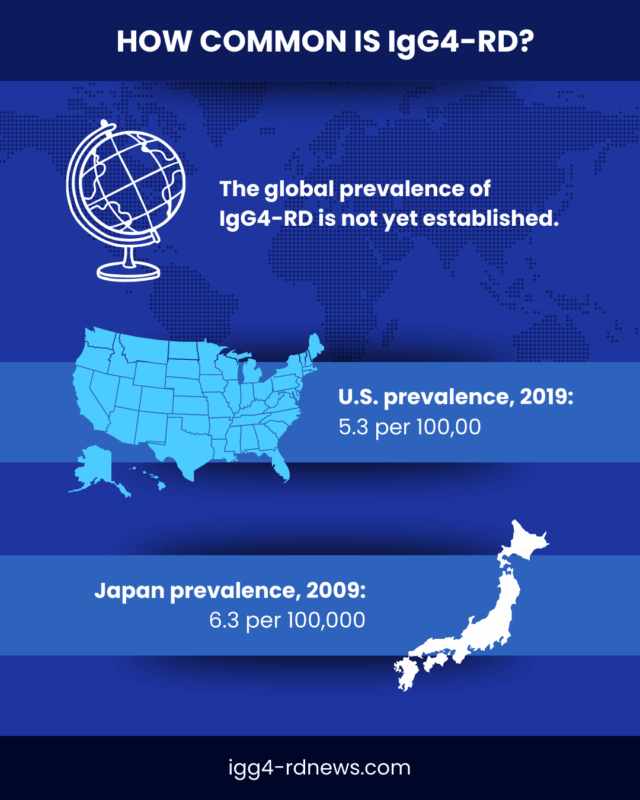
- In 2019, the IgG4-RD prevalence in the U.S. was 5.3 people per 100,000, meaning that for every 100,000 people in the U.S., 5.3 of them would be expected to have IgG4-RD.
Methodological limitations of the study mean that these estimates may not account for underinsured or other underrepresented populations.
A survey study estimated that about 8,000 people in Japan were living with IgG4-RD in 2009, corresponding to an approximate prevalence of around 6.3 per 100,000 based on the national population at that time. Another survey study estimated that the disease incidence between 2003 and 2009 was about 0.28-1.08 per 100,00, corresponding to 336-1,300 people diagnosed each year.
Peer-reviewed epidemiological studies from other regions are lacking, and it cannot be definitively established that IgG4-RD is more or less common in certain regions due to differing diagnostic practices and analytical methods.
IgG4-RD demographics
IgG4-RD can occur at any age, but it primarily affects middle-aged or older adults between the ages of 50 and 70. Most clinical profiles are more common in men.
People with a history of smoking and those with occupational exposure to certain chemicals may also be at a higher risk of IgG4-RD.
Why IgG4-RD prevalence estimates vary
Several factors make it challenging to generalize estimates of IgG4-RD prevalence, including:
- low clinical awareness and a lack of universal diagnostic guidelines
- limited long-term data, and small numbers of participants in studies
- unequal access to imaging and diagnostic tools
- geographic differences in data collection, analytical methods, and reporting
Many of these challenges stem from the fact that IgG4-RD was only recognized as a distinct condition in the past 20 years.
As the understanding of the possible range of IgG4-RD symptoms has grown, medical organizations have worked to develop better diagnostic criteria for IgG4-RD; however, these criteria aren’t universally applied.
Geographical differences in clinical recognition, diagnostic practices, and access to diagnostic tools likely contribute to more substantial underdiagnosis in some regions relative to others.
Implications of low IgG4-RD prevalence
While low disease prevalence doesn’t inherently suggest underdiagnosis, researchers believe that this may be the case for IgG4-RD. For example, one study showed that over 60% of people with IgG4-RD were initially misdiagnosed with cancer, leading to diagnostic delays.
These delays prevent early treatment and can lower the chances that a person will achieve disease remission — where symptoms stabilize or disappear — and negatively affect IgG4-RD life expectancy.
Efforts to increase clinical recognition of IgG4-RD are underway, emphasizing that early diagnosis and prompt treatment lead to better outcomes. As awareness increases in the coming years, the reported prevalence of IgG4-RD is expected to rise. If so, this would likely reflect more accurate and prompt diagnostic practices rather than a true increase in disease frequency.
IgG4-RD News is strictly a news and information website about the disease. It does not provide medical advice, diagnosis, or treatment. This content is not intended to be a substitute for professional medical advice, diagnosis, or treatment. Always seek the advice of your physician or other qualified health provider with any questions you may have regarding a medical condition. Never disregard professional medical advice or delay in seeking it because of something you have read on this website.