
Shedding a light on hidden disabilities to improve understanding
Just because a disability is invisible doesn't mean it isn't real
Written by |




Did you know that 1 in 6 people has a disability? Don’t worry if you didn’t, because about 80% of disabilities are invisible.
Invisible or hidden disabilities are those that lack obvious or visible signs, such as using a cane or wheelchair, or having a noticeable physical difference. These disabilities can be temporary, situational, or permanent, encompassing a wide range of conditions, including visual and hearing impairments, neurological and cognitive disorders, autoimmune diseases, and cancers.
The fact that the majority of disabilities are invisible calls for more discussions and open acknowledgement of these unseen challenges. It’s crucial for society to recognize that disabilities exist on a broad spectrum. A common misconception is that those with invisible conditions lead struggle-free lives.
Like many people living with invisible disabilities, I have faced judgment, discrimination, and blatant ignorance as someone with IgG4-related disease. Sometimes this comes from within the medical system, but it also includes friends, family members, peers, and strangers I encounter in everyday situations. I am constantly monitoring myself and making adjustments to avoid flare-ups, which can put me in real danger.

One of my biggest challenges arises when I travel. The journey can leave me utterly exhausted, both physically and mentally. The flight involves changes in barometric pressure and altitude that inflame my glands and reduce blood flow, resulting in severe vertigo and an increased likelihood of a dysautonomia flare. The burden of heavy luggage and navigating the airports can be overwhelming.
People see me standing and walking, so they assume I am fine. However, I can only stand and walk for short periods without risking an autonomic dysfunction flare-up. After a flight, my vulnerability increases. These episodic flares require me to lie flat to recover; otherwise, I may start convulsing, sweating uncontrollably, and hyperventilating, making communication nearly impossible, and I risk fainting.
About a year ago, during a return trip, I had requested wheelchair assistance. I do this when I’m experiencing active symptoms or when I know the airport is large and has long lines. Even on good days, I remain mindful of how much I exert myself.
Upon landing, I had assistance all the way to baggage claim. Unfortunately, once outside the airport doors, I suffered a severe flare that visually resembled a seizure. People passed by me on the ground, staring without offering help, their expressions reflecting judgment and disdain.
In that moment, I felt both neglected and ashamed, despite knowing that shame should not be part of my experience. Although I strive to ignore others’ opinions, their negativity can dramatically affect my well-being during such critical times.
How can we amplify what remains invisible?
I discovered the Hidden Disabilities Sunflower program, which supports people with invisible disabilities who encounter discrimination and a lack of recognition. The sunflower lanyard, when worn around the neck, signals that the wearer has a hidden disability and may require extra time, patience, or assistance.
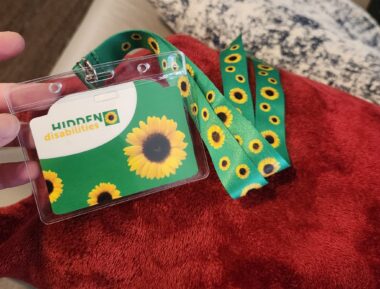
My Hidden Disabilities Sunflower lanyard. (Photo by Mahsa Pazokifard)
I received my sunflower lanyard and used it on a recent trip. While it wasn’t acknowledged at the airport I departed from, it was recognized upon arrival at my destination. After exiting the airport and searching for the designated pickup zones, I began to lose consciousness, and my upper body muscles were clearly spasming.
An airport staff member, noticing my distress, rushed to my side. When she saw my sunflower lanyard, she exclaimed, “They shouldn’t have let you walk out by yourself!” Without hesitation, she ran to get a wheelchair and some water while managing my luggage. She ensured I reached my ride and got in safely.
It was a first for me, having my invisible disability recognized without judgment and being treated with compassion and care.
In sharing my experiences, I hope to illuminate the challenges faced by those with invisible disabilities and the importance of compassion and understanding. The Hidden Disabilities Sunflower program is a step toward fostering a more inclusive environment where everyone, regardless of their condition, feels seen and supported.
As a society, we must strive to create spaces where people can openly discuss their difficulties without the fear of stigma. Awareness is key — just because a disability isn’t visible doesn’t mean it isn’t real.
Let’s all commit to being allies by providing a helping hand or a kind word when we encounter someone dealing with an invisible struggle. Together, we can shed light on the unseen, ensuring no one feels neglected or ashamed.
Empathy and understanding can transform lives; let’s work to create a world where everyone is embraced with dignity and respect.
Note: IgG4-RD News is strictly a news and information website about the disease. It does not provide medical advice, diagnosis, or treatment. This content is not intended to be a substitute for professional medical advice, diagnosis, or treatment. Always seek the advice of your physician or other qualified health provider with any questions you may have regarding a medical condition. Never disregard professional medical advice or delay in seeking it because of something you have read on this website. The opinions expressed in this column are not those of IgG4-RD News or its parent company, Bionews, and are intended to spark discussion about issues pertaining to IgG4-RD.


Leave a comment
Fill in the required fields to post. Your email address will not be published.