
Mikulicz disease: The multiglandular monster that lives in my head and neck
A biopsy of my lacrimal gland was the turning point in my IgG4-RD journey
Written by |


Mikulicz disease — a rare pattern of organ involvement linked to IgG4-related disease (IgG4-RD) — is often misunderstood. This deeply disruptive condition is multiglandular, affecting the lacrimal glands (which produce tears), the parotid and submandibular glands (major salivary glands), and the lymphatic chain in the head and neck. When it flares, it can cause chaos.
For me, Mikulicz is bilateral, but the left side has always been more aggressive. My flares begin quietly, with a subtle pressure behind my eye, around the ear, and under my jaw. Within hours, that pressure becomes fullness, then swelling, then a complete takeover of my face, including tremors, a partially locked jaw, and trouble hearing and breathing. My lacrimal glands swell and dry out. My left eye will simultaneously droop and bulge out. My parotid glands harden like stones. The lymph nodes in my neck throb, and a major internal ache radiates into my temples, ears, and jaws. It is not just swelling; it is distortion and heaviness, a combination of brain fog, slurred speech, and difficulty speaking. To some, I look like I am quietly seizing while also becoming stiff. It is very taxing on the body.
This is the part of Mikulicz that most people never see, and that many clinicians underestimate.

Mikulicz syndrome in IgG4-RD
My path to diagnosis was paved through these glands. After years of being dismissed, redirected, and minimized, I finally found a surgeon who agreed to biopsy my lacrimal gland. It was not a simple day procedure; it was a marathon. The surgical team had started their day at 5 a.m., and I was their last patient, taken in at 8 p.m. I kept waking up during the procedure because I have a high tolerance to anesthesia. It was a stressful day.
The recovery was brutal. My eye was swollen shut for seven days, then barely opened for another 10. The bruising lasted almost three weeks. It took a full month for my face to look like mine again.
Many people assume the surgery itself is the scary part. But for me, the scary part was being homebound, irritated, uncomfortable, and dealing with disease progression without a diagnosis or treatment in view. It was the frustration and agitation of feeling trapped inside a body that was already fighting multiple battles.
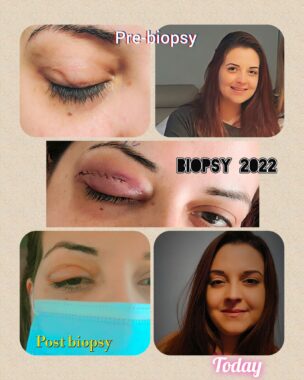
Mahsa Pazokifard’s lacrimal gland involvement is pictured before and after her biopsy in 2022. (Courtesy of Mahsa Pazokifard)
But I would do it again without hesitation. That biopsy was the turning point of my journey — the moment I finally had proof and realized that my voice mattered. Having my experience validated lit a fire under me that hasn’t gone out.
I also had a lower lip biopsy to confirm salivary involvement. Thankfully, I did not need to biopsy my parotid glands or lymph nodes, though I would eventually have other organs biopsied to look for conditions that may or may not be related to my IgG4-RD. That is the nature of a rare disease that can mimic many other illnesses. Nobody definitively knows what will or won’t happen. It seems anything is possible with IgG4-RD.
I believe one of the worst things a clinician can do is to ignore a symptom simply because it’s rare. If our symptoms are ignored, we will never learn the truth about the culprit behind them. Please listen to our lived experiences. If our blood work doesn’t indicate a problem, look deeper. This disease does not fit into a standard box, and it should be taken seriously, whether it appears active or not.
Today, I have to regularly undergo imaging, testing, and in-person evaluations to monitor my disease activity. Insurance companies don’t have a good track record when it comes to approving test orders for seronegative, systemic IgG4-RD patients like me. Everything is five times harder.
So here is my message to patients: Trust your gut. Push for testing and procedures. Some may call it invasive, but ask yourself this: Is it more invasive to undergo a procedure that could lead to a diagnosis and treatment, or to risk a potentially life-threatening outcome?
And to the medical community: It is time to get curious and creative. Think outside the box. IgG4-RD isn’t subtle or predictable, and our approach shouldn’t be, either.
Note: IgG4-RD News is strictly a news and information website about the disease. It does not provide medical advice, diagnosis, or treatment. This content is not intended to be a substitute for professional medical advice, diagnosis, or treatment. Always seek the advice of your physician or other qualified health provider with any questions you may have regarding a medical condition. Never disregard professional medical advice or delay in seeking it because of something you have read on this website. The opinions expressed in this column are not those of IgG4-RD News or its parent company, Bionews, and are intended to spark discussion about issues pertaining to IgG4-RD.

Leave a comment
Fill in the required fields to post. Your email address will not be published.